
Planning a big renovation, thinking about getting an EV charger installed, or just bought a classic Victorian terrace in London?
One question you’re going to run into pretty quickly is:
❓ What is my service amperage?
It sounds technical, but service amperage simply refers to the maximum amount of electrical current flowing into your property from the street. If you don’t know this number, you risk overloading your system or discovering too late that your home lacks the capacity for modern upgrades like a heat pump.
You don’t need to be a qualified sparky to find this number, though it can sometimes be a bit tricky to spot. In this guide, we’re cutting straight to the chase. We’ll show you exactly where to look, what to avoid touching (seriously, safety first!), and what to do if your electrical service isn’t quite up to scratch for modern living.
Where to Check Your Service Amperage
If you’re in a rush and just need the number, head straight to your electricity meter cupboard or the area under the stairs where your fuse box lives. You aren’t looking at the trip switches (circuit breakers); you are looking for the main fuse (also called the service head or cut-out).
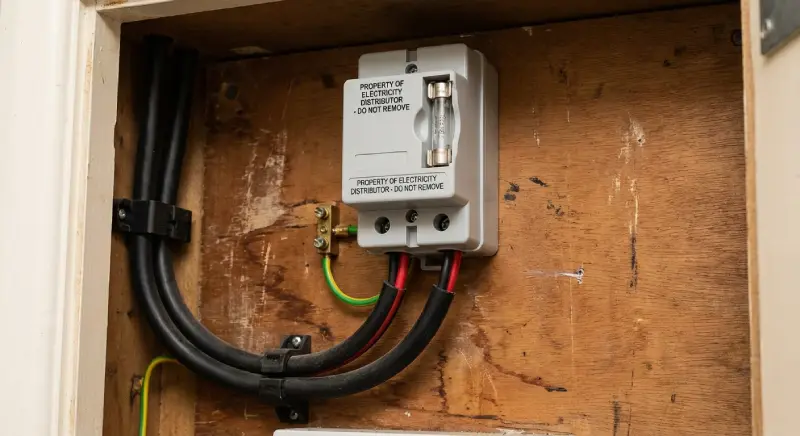
This is usually a black or grey box where the thick cable comes in from the street. Look for a label or a sticker on the side of that box. It will typically say “60A”, “80A”, or “100A”. That number is your service amperage.
If there’s no label, don’t guess. We’ll explain exactly how to handle that situation below without putting yourself at risk.
If you’re based in:
- Chiswick
- Ealing
- Hammersmith & Fulham
- Holland Park
- Kensington & Chelsea
- Knightsbridge
- Kew
- Kingston upon Thames
- Mayfair
- Putney
- Richmond
- Sutton
- Twickenham
- Wimbledon Village
, you can call SMR GROUP on 07789484208 for a fast, reliable 24-hour emergency electrician. We offer immediate response, competitive pricing, and fully qualified local electricians who can reach you quickly.
What Exactly Is Service Amperage?
Before we start poking around in cupboards, let’s get the definitions sorted. Your service amperage is the maximum amount of electrical current your home is allowed to draw from the grid at any one time. Think of it like the width of a water pipe entering your house. The wider the pipe (higher amperage), the more water (electricity) can flow through at once to power your shower, washing machine, and kettle simultaneously.
In the UK, and specifically in older London properties, this is controlled by the main fuse. If you try to pull more power than your service amperage allows—say, by charging a car, running an electric shower, and boiling the kettle all at once on a low-amp supply—that main fuse will blow to protect the cables from melting. And unlike a trip switch, you can’t just flick this one back on. You’ll be in the dark until the power network comes to fix it.
❌ The “Main Switch” Myth: Don’t Be Fooled
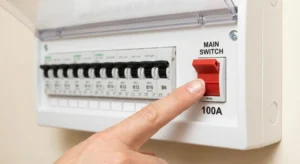 Here is the biggest mistake we see homeowners make. They open their home electrical system panel (the consumer unit with all the trip switches), see a big red switch that says “100A”, and assume that is their supply rating.
It is not.
That switch is just a disconnect switch. The “100A” written on it just means the switch can handle up to 100 Amps without melting. It does not tell you how much power is actually coming into the house. You could have a 100A switch on your fuse box, but if the main fuse in the cut-out is only 60A, your total service amperage is still only 60A.
Method 1: Inspecting the Main Intake (The Cut-Out)
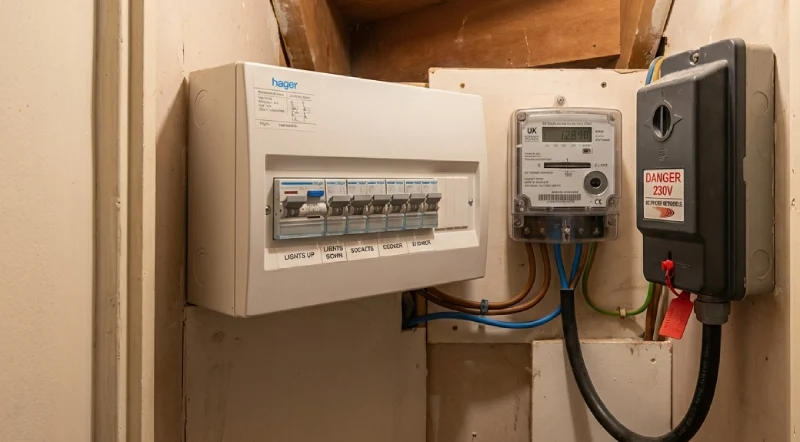
The most reliable way to find your service amperage is to look at the service head. In the trade, we call this the “cut-out.” This is the property of the Distribution Net
work Operator (DNO), not your energy supplier.
Identifying the Cut-Out
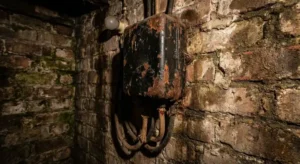 In most London homes, this will be next to your electricity meter. It’s distinct from your consumer unit (fuse box).
• Older homes : It might be a cast-iron box (very old!) or a black plastic box.
• Modern homes: It’s usually a grey plastic unit.
Reading the Label
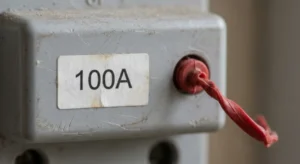
Grab a torch and get up close (but don’t touch). You are looking for a sticker or embossed text that indicates the rating.
1.“100A”: This is the gold standard for modern homes. If you see this, your service amperage is likely 100 Amps, which is plenty for most upgrades.
2.“60A” or “60/80A”: Common in older flats or terraces that haven’t been updated since the 1970s.
3.No Label: This is frustratingly common. If the sticker has fallen off or been painted over (a classic DIY mishap), you cannot assume the rating.
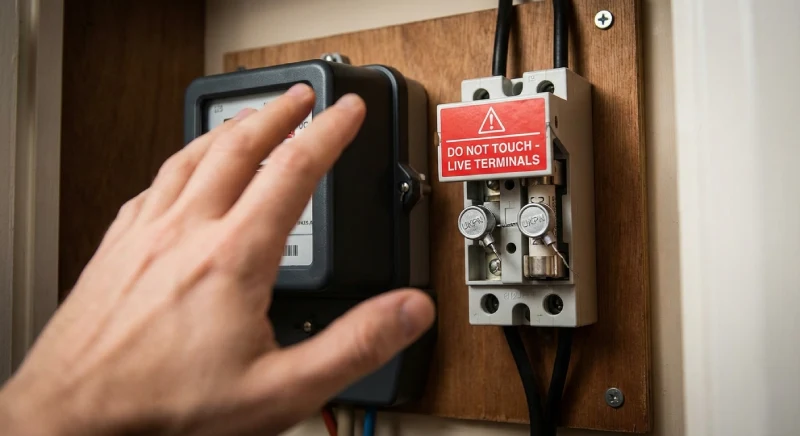
Warning: Never, under any circumstances, try to open this box, pull the fuse out, or break the wire seals. That is illegal and incredibly dangerous. If you can’t see the label, move to Method 2.
Method 2: Check Your Electricity Meter
If the cut-out box is a mystery, sometimes the electricity meter itself holds a clue. While the meter doesn’t dictate the limit, it is rated for a specific maximum load.
Look at the face of your meter. You might see text like:
- 10 – 40 A (Very old, unlikely in a functional home)
- 20 – 80 A
- 40 – 100 A
If your meter says “40 – 100 A”, it suggests the system was designed for a higher capacity, but it doesn’t guarantee the fuse inside the cut-out is 100A. However, if the meter is rated max 80A, it is highly unlikely your service amperage is 100A.
Method 3: The Surefire Way – Ask the DNO
If you can’t find a label, or you suspect the label is wrong (sometimes a 100A carrier holds a 60A fuse), the only way to be 100% certain is to ask the people who own the equipment.
In London, your Distribution Network Operator is usually UK Power Networks. They keep records of the supply to your property.
- Find your MPAN (Meter Point Administration Number) on your electricity bill. It is usually a 21-digit number located in a box marked with a large ‘S’.
- Call UK Power Networks or visit their website.
- Ask them: “What is the service amperage for my property?”
Sometimes their records are incomplete, especially for ancient Victorian conversions, and they may need to send an engineer to do a site visit. They might stick a new label on it for you while they are there.
If you’re based in:
- Chiswick
- Ealing
- Hammersmith & Fulham
- Holland Park
- Kensington & Chelsea
- Knightsbridge
- Kew
- Kingston upon Thames
- Mayfair
- Putney
- Richmond
- Sutton
- Twickenham
- Wimbledon Village
, you can call SMR GROUP on 07789484208 for a fast, reliable 24-hour emergency electrician. We offer immediate response, competitive pricing, and fully qualified local electricians who can reach you quickly.
🔌 Why Your Service Amperage Matters for EV Chargers
This is a critical consideration for modern homeowners.
A common issue we see involves residents purchasing an EV charger, only to discover their existing electrical supply cannot handle the load.
A typical home EV charger draws about 32 Amps.
Now, let’s do some quick maths to see why this is a problem for older systems:
Supply Capacity: 60 Amps (Typical older home)
The Demand:
- EV Charger : 32 Amps
- Electric Shower : + 40 Amps
- Total Load : 72 Amps
Result : 72A > 60A = Overload (Main Fuse Blows)
If you turn on the shower while the car is charging, the main fuse will likely blow because the total demand (72A) exceeds your supply limit (60A). You are literally in the dark. To install a charger safely, you usually need a service amperage of at least 80A, but 100A is preferred to be safe. If you have a 60A fuse, you will almost certainly need an electrical service upgrade to support fast car charging.
Common Service Amperage Levels in UK Homes
Understanding what you are working with helps you plan your renovations. Here is the breakdown of what we typically see across the capital:
60 Amp Service
This is very common in pre-war properties or flats in London that haven’t had a major electrical overhaul. It’s fine for lights, a TV, and a gas cooker. It is not fine for electric showers, induction hobs, and EV chargers all running at once.
80 Amp Service
This is a decent standard. Many homes built or rewired in the late 20th century have this. You can usually get away with an EV charger here, provided you don’t have multiple high-draw appliances running simultaneously (like two electric showers).
100 Amp Service
This is the modern standard. If you are building a new house or doing a full electrical upgrade, this is what you want. A 100A service amperage gives you plenty of headroom for heat pumps, hot tubs, and fast car charging without worrying about tripping the main supply.
Signs Your Service Amperage Is Too Low
How do you know if you are pushing your limit without checking the fuse?
Your home electrical system will give you hints, though they can be subtle until it’s too late.
- Dimming Lights: When the washing machine motor kicks in or the shower turns on, do the lights dip momentarily? This is a sign of voltage drop caused by high load.
- Warm Plastic Smell: If you smell fishy or burning plastic near your meter cupboard, search for a local electrician. This suggests the cables or fuse holder are overheating.
- Tripping Breakers: While usually a circuit issue, if your main switch feels hot to the touch, you are drawing too much current.
The “Looped Supply” Issue in London
This is a massive topic for London terraces. A “looped supply” is where the main electrical cable comes into your house, feeds your fuse, and then goes back out through the wall to feed your neighbour’s house. You and your neighbour are effectively sharing one main cable.
If you have a looped supply, you might find it impossible to upgrade your service amperage without the DNO digging up the pavement to lay a new cable. It’s a bit of a headache, but spotting it is easy: look at your cut-out. If there are two thick cables entering the bottom of the box instead of one, you are likely looped.
How to Check if the Fuse Rating is Genuine
Just because the plastic holder says “100A”, it doesn’t mean there is a 100A fuse inside. The plastic bit is just the carrier. An electrician might have put a 60A fuse inside a 100A carrier for safety reasons if the cables were too thin.
The only way to know for sure is to have a qualified person verify it. We have seen plenty of homes where the owner thought they had a high service amperage, only to find out during an installation that it was downgraded years ago.
When Do I Need an Electrical Upgrade?
You should consider upgrading your supply if:
- You are installing an EV charger.
- You are switching from a gas boiler to a Heat Pump (these draw a lot of constant power).
- You are adding a large extension with a new kitchen (induction hobs consume a lot of amps).
- You are converting a house into flats.
An electrical upgrade isn’t something a standard sparky does alone. It involves coordination between your electrician (who upgrades your consumer unit and internal tails) and the DNO (who upgrades the fuse and incoming cable).
Can an Electrician Check This For Me?
Absolutely. In fact, if you are unsure, it is the safest route. Searching for an electrician near me and getting them to do a “load test” or a site survey is smart.
A qualified electrician from SMR Group can:
- Inspect the cut-out visual condition.
- Measure the size of the “meter tails” (the cables connecting the meter to your fuse box). If these are too thin (16mm²), they can’t handle 100A even if the fuse can.
- Calculate your maximum demand to see if you actually need an upgrade.
- Liaise with the power network on your behalf.
If you’re based in:
- Chiswick
- Ealing
- Hammersmith & Fulham
- Holland Park
- Kensington & Chelsea
- Knightsbridge
- Kew
- Kingston upon Thames
- Mayfair
- Putney
- Richmond
- Sutton
- Twickenham
- Wimbledon Village
, you can call SMR GROUP on 07789484208 for a fast, reliable 24-hour emergency electrician. We offer immediate response, competitive pricing, and fully qualified local electricians who can reach you quickly.
Safety First: What NOT to Do
We cannot stress this enough. We’ve seen some dodgy DIY attempts in our time.
- Never break the seals: The wire seals on the fuse box are legally required. If they are missing, you could be accused of tampering.
- Never pull the fuse: This exposes live parts with no protection. It is lethal.
- Never upgrade the fuse yourself: Putting a 100A fuse into a holder designed for 60A will melt the equipment and could cause a fire.
Calculating Your Total Home Load
If you want to get nerdy about your service amperage, you can do a rough calculation of your usage. This is called “diversity” in the electrical trade—we assume not everything is turned on at once.
However, for a rough idea, add up the Amps of your biggest appliances:
- Electric Shower: 40A
- Cooker/Hob: 30A
- Immersion Heater: 16A
- Sockets (Ring Main): 32A
- Lights: ~6A
It looks like a lot, right? But because you rarely run the shower and the oven at full blast simultaneously, a 60A or 80A supply usually copes. The problem arises when you add “constant” loads like EV chargers that run at full power for hours. That is when your service amperage becomes critical.
Preparing for a Service Upgrade
If you’ve determined your amps are too low, here is the process:
- Contact SMR Group: We can assess your current home electrical system and prepare the internal wiring (tails and consumer unit) to be ready for the higher power.
- Apply to the DNO: You apply to UK Power Networks for a supply upgrade (e.g., from 60A to 100A).
- The Visit: The DNO comes out, swaps the cut-out and fuse.
- Connection: We connect your new consumer unit to the upgraded supply.
It’s a bit of admin, but it adds value to your home and future-proofs it for the next 20 years.
Why Using a Local London Expert Matters
Electrical systems in London are a mixed bag. You’ve got wiring from the 50s sitting next to smart meters from 2024. A generic guide might not mention things like looped supplies in terraced housing or the specific requirements of UK Power Networks.
Using a local service like SMR Group means we know exactly what the local infrastructure looks like. We know the difference between a standard setup and a messy conversion that needs serious attention.
If you’re based in:
- Chiswick
- Ealing
- Hammersmith & Fulham
- Holland Park
- Kensington & Chelsea
- Knightsbridge
- Kew
- Kingston upon Thames
- Mayfair
- Putney
- Richmond
- Sutton
- Twickenham
- Wimbledon Village
, you can call SMR GROUP on 07789484208 for a fast, reliable 24-hour emergency electrician. We offer immediate response, competitive pricing, and fully qualified local electricians who can reach you quickly.
📞 Conclusion
Knowing your service amperage is the first step in any modern home project. Whether you are looking at a simple label on a grey box or chasing down paperwork from the DNO, getting this number right ensures your home is safe and ready for the future.
If you are stuck, or if that fuse box looks like a spider’s web of confusing wires, don’t risk it. Give SMR Group a shout. We can conduct a full survey, tell you exactly what your service amperage is, and help you plan your next electrical upgrade without the headache.
Ready to get your home powered up properly? Get in touch with us today.
Related articles:
- Hidden Electrical Dangers Landlords Miss
- Roles & Responsibilities of an Electrician in London
- do i really need an electrical certificate for my house ?
- NICEIC Approved Residential Electricians London
- lectrical Safety Rules for London Properties